
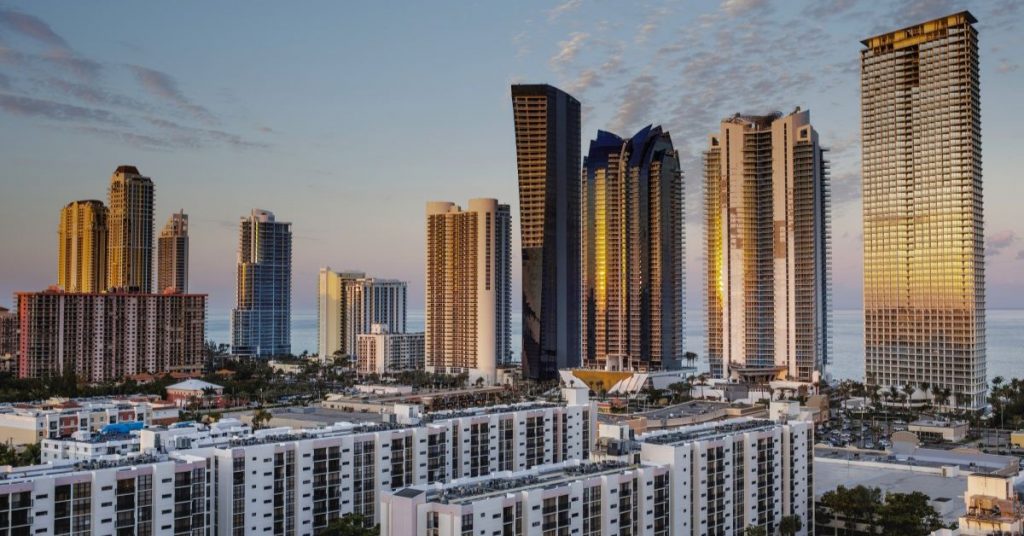
Unseen forces are at work beneath the luxury towers that line barrier islands like Sunny Isles Beach.
Construction drilling can shift soil and rattle nearby buildings. Rising seas and higher tides push more water underground, flooding parking garages with corrosive saltwater. And deeper below, aging stormwater systems may be weakening the porous limestone that underlies South Florida.
These factors may all contribute to the unexpected subsidence recorded in some Miami-Dade coastal high-rises. A University of Miami study found that 35 buildings from Miami Beach to Sunny Isles Beach sank as much as 3.1 inches between 2016 and 2023. But a Miami Herald investigation shows engineers began noticing far more settling than expected as early as the mid-2000s — in some cases, two to three times original predictions.
Even after decades of rapid development, experts still lack firm answers about what’s driving the sinking. One thing is clear: building on islands made of shifting sand and porous rock carries unique uncertainties.
“There is some characteristic there that is allowing, or causing, this movement … a characteristic of the soil,” said Rick Slider of Slider Engineering, one of more than a dozen specialists interviewed.
Their consensus: the underground dynamics of barrier islands and South Florida’s limestone are complex, insufficiently studied, and poorly understood — especially under the immense pressure of today’s massive towers. And the stakes are high. Real estate and construction generate about $50 billion annually in Miami-Dade County, according to the U.S. Bureau of Economic Analysis.
“So much rests on real estate in Florida that it would be criminal to ignore the slightest risk to our wealth or well-being,” said Jean-Pierre Bardet, a University of Miami engineering faculty member.
Sunny Isles Beach, transformed by a boom in luxury towers, may serve as a critical case study for future coastal development.
Vibration: A Leading Suspect

Construction-related vibration is a well-known risk. Residents often feel the shaking, and building codes set limits to prevent structural damage. Contractors must survey nearby buildings and are liable for damage. But vibration can also change the ground itself. Shaking causes sand to compact — like tapping a can of coffee — reducing air pockets and allowing buildings to sink into newly settled soil.
A 2023 geotechnical report for the Bentley Residences, expected to be one of the tallest towers in the city, warned that its construction could cause up to three inches of settlement in neighboring structures. Vibration is such a concern that new sensors marketed to detect tiny ground movements are beginning to appear, though few South Florida buildings use them.
Water: The Other Major Suspect
Rising seas only worsen the process: groundwater is pushed higher, and tidal flooding becomes more frequent.
“On a barrier island, groundwater sits just a few feet below the surface. Add vibration and that water can mobilize sand, allowing grains to shift and compress under the weight of a building,” said Sinisa Kolar of the Falcon Group.
Engineers have successfully built large structures on barrier islands for decades, but Sunny Isles’ extremely tall, slender towers place unprecedented pressure on small parcels of land. The amount of settling seen in some buildings suggests something previously unaccounted for may be happening beneath the surface.
Is The Bedrock Dissolving?

Another potential factor is the gradual dissolution of limestone — South Florida’s porous, calcium-carbonate bedrock. Rain and fresh water naturally erode limestone each year. In coastal zones, the mixing of fresh and saltwater accelerates this process, forming underground voids like those seen in the Bahamas and Yucatán. Sea-level rise — up four inches since 1993 — is pushing this reactive zone farther inland and deeper underground.
Geochemist Peter Swart warns that no one knows how quickly this dissolution is occurring beneath heavily developed areas. Over centuries, it could contribute to instability. Ironically, the stormwater drainage wells used to keep barrier islands dry may be speeding up the process by injecting fresh water deep into the limestone. Thousands of such wells exist, some drilled roughly 100 feet down. Neither engineers nor regulators can yet quantify their impact. Despite these concerns, South Florida has historically avoided confronting issues that could slow development.
“They stick their head in the sand,” Swart said.
Behind The Reporting
Following last year’s UM study on subsidence, the Miami Herald obtained more than 40 geotechnical reports for Sunny Isles Beach oceanfront towers through public records. Reporters analyzed over 2,000 pages, sought expert review, and interviewed more than a dozen specialists.
Source: Miami Herald
