
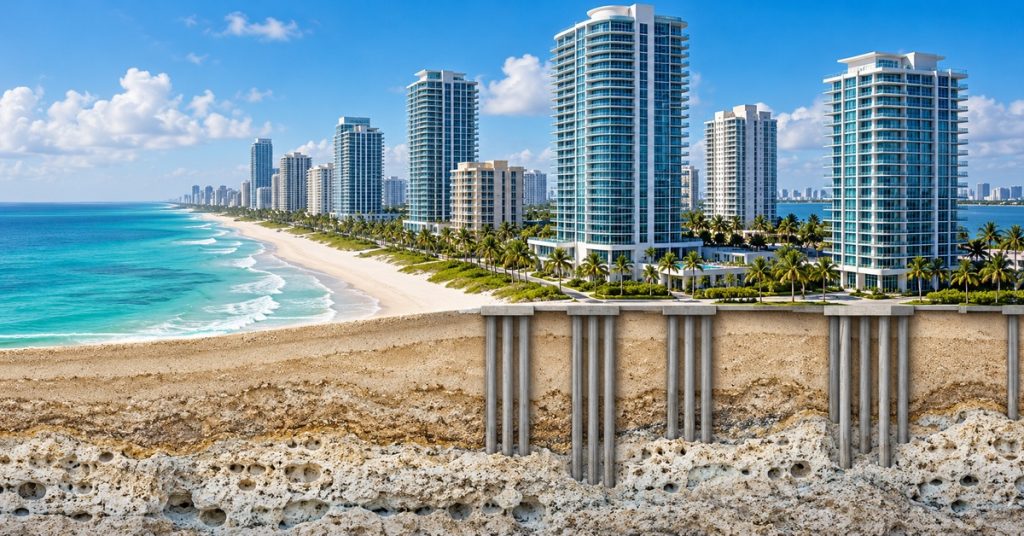
A coastal development site’s potential depends on more than its location, zoning and waterfront views. New University of Miami research is drawing attention to another factor that can affect a project’s costs long after construction: how the ground responds to the weight of a building.
According to an October 20 Miami Herald report, researchers have identified uneven settlement in some Miami-Dade high-rises previously found to be sinking more than anticipated. The findings raise questions about foundation design, neighboring construction and the length of time buildings should be monitored.
For landowners and developers, the research reinforces the importance of understanding subsurface conditions before establishing what a site can support economically.
Ground Conditions Can Shape a Project’s Economics
Miami-Dade’s barrier islands contain layers of sand, silt, porous limestone and, in some locations, peat. Designing foundations for substantial buildings on that terrain requires engineers to anticipate how those materials will behave under heavy loads.
The Herald reported that concerns about settlement have already influenced development plans. At the Bentley project in Sunny Isles Beach, developers reduced the planned height by approximately three floors. Engineers recommended foundations extending roughly 200 feet below ground for the remaining 716-foot tower.
Decisions like these connect geology directly to development feasibility. Additional foundation work or changes to a building’s size can alter construction budgets and the assumptions behind a land purchase.
Why Uneven Movement Matters
Some settlement is expected after a high-rise is built. The concern highlighted by the latest research is that different portions of a building can move at different rates.
University of Miami professor Falk Amelung’s earlier research identified at least 35 buildings along Miami-Dade’s barrier islands that continued settling years after construction. His newer analysis uses satellite measurements from multiple points on individual buildings to identify differences in that movement.
Amelung told the Herald that the additional data confirmed uneven settlement in some of those towers. He presented the research at a European Space Agency conference in June, with more detailed findings still awaiting publication.
Uneven movement can place stress on building components, potentially contributing to damaged pipes, cracked surfaces, misaligned doors and uneven floors. However, the findings do not establish that the buildings face an immediate safety threat. Sunny Isles Beach told the Herald in 2025 that it had received no reports of settlement-related damage.
Construction Risk Can Extend Beyond a Property Line
The research also raises questions about how foundation work may affect surrounding properties. Researchers have suggested that construction vibrations could compact nearby soil and contribute to settlement.
The Herald described a lawsuit in which the Millennium condominium association attributed building damage to construction of the neighboring Porsche Design Tower. The association sought nearly $4 million for repairs before reaching an undisclosed settlement. Those allegations do not establish that nearby construction caused every reported defect, but they illustrate the potential financial exposure surrounding such disputes.
Some associations are responding with monitoring equipment. Marenas Beach Resort installed a $20,000 sensor system during construction of the neighboring St. Regis project to document small changes within its building.
A Due Diligence Consideration for Landowners
The findings concern coastal high-rises and should not be generalized to every residential development site. Still, they offer a useful lesson for owners preparing land for sale or development: subsurface conditions deserve attention early in the process.
Geotechnical investigations, foundation requirements and the proximity of existing buildings can influence a buyer’s assessment of cost and risk. Understanding those issues can help landowners develop more realistic expectations about a property’s development potential—and prepare for the questions a prospective builder will ask.
Source: Miami Herald
